The room Inside the case What it screens Reading by reading The visit Consent at a door What one person carries Where the record goes After a flagged result Clinics On Cloud +91 8999 073 447 sales@clinicsoncloud.com Enquire Now
The field side, not the specification

The case opens on a table. Somebody else’s table.

A box clinic takes the building out of screening. What it cannot take out is the room it ends up in - a front room, a courtyard, a corridor - and every reading it produces is produced there. Some readings barely notice. Blood pressure, glucose and an ECG notice a great deal.

This page is about that room: what it does to a number, what consent means when the clinic knocks rather than being walked into, and what happens to a flagged result found in somebody who cannot travel to a clinic. Written by Clinics On Cloud, who build the case at Chakan.

Reading by reading
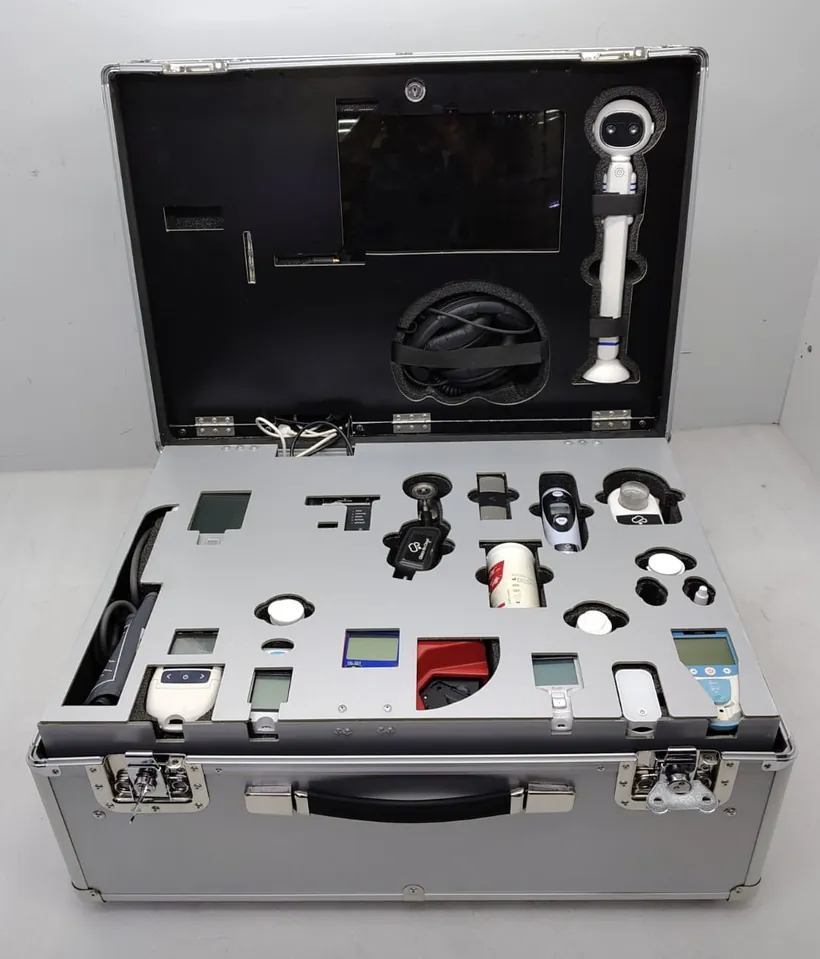
A Clinics On Cloud Box Clinic open, devices in foam slots with the tablet in the lid
Every device in its own slot, tablet in the lid. What the case cannot carry is the room it gets opened in.
The room you did not choose

A doorstep is a clinical environment. Just not a controlled one.

The case removes the building. It cannot remove the room it ends up in - a front room, a courtyard, a school corridor, a patch of shade outside a site office. Six things are different there, and they are different for everybody you screen, not occasionally.

Nobody is fasting

Or somebody is, and nobody wrote down which. At a doorstep the same test means two different things before and after breakfast, and the difference is not visible in the number afterwards.

She just walked in

From the field, up the stairs, or from calling the neighbours in. A reading taken in the first minute of sitting down is a reading of the walk.

There is nowhere to sit properly

A chair with a back, feet flat, arm supported - that is what the device manuals assume. A cot, a stool or a doorstep is what is there.

There is no door to close

Which decides whether a woman can be examined at all, whether an ECG happens, and whether anyone answers a mental-health question honestly.

The family is in the room

And often answers for her. A history taken through a husband or a son is a different history, and the worker has to know that before it happens.

Light, noise and dust

Vision screening needs light and distance. A stethoscope needs quiet. Strips and lancets need a clean surface that a courtyard does not offer.

Inside the case

Every foam slot is a decision about what you can do at a door.

Published contents, listed here because at a doorstep the case is the whole hospital - whatever is not in it is not happening today. The tablet and the examination camera sit in the lid; everything else is in the tray below it, paired to the tablet.

The Box Clinic closed, branded lid, corner guards and trolley wheels
What arrives An aluminium flight case with corner guards and locking latches. It looks like luggage on purpose - at a door that matters more than it sounds.
The Box Clinic stood upright on its trolley wheels with the pull handle out
How it travels Upright on trolley wheels with a pull handle, and a side grip for the stairs and thresholds the wheels cannot take.
The Box Clinic open, every device in its own foam slot with the tablet in the lid
What it becomes Open on a table, every instrument in its own slot. This is the whole clinic, and the table is somebody’s own.

Vitals and examination

BP monitor, temperature probe, pulse oximeter, smart stethoscope, spirometer and a body-composition scale. The scale is the one that needs a floor the house may not have.

Point-of-care analyzers

Glucometer, haemoglobin analyzer, lipid profile device and HbA1c tester - blood results in the field, from a finger rather than a vein.

Consumables and the ordinary things

Lancets, strips and prep pads, plus compartments for scissors, tape and masks. The unglamorous half, and the half that runs out.

The tablet in the lid

Devices pair to it and it guides the session step by step, which is what lets a trained non-clinician run the workflow at all.

The examination camera

For the look a stethoscope cannot give, and for the doctor at the other end of the teleconsultation to see what the worker is seeing.

The case itself

Rugged aluminium shell, corner guards, locking latches and trolley wheels. Built to be carried by one person, which is also what limits how far that person goes in a day.

The menu

65+ parameters across 14 specialities. The door decides which happen today.

This is Clinics On Cloud's published screening menu, and it is the same one the fixed kiosk carries - their own answer is that a Health Box and a Health Kiosk have no major difference in capability. What changes at a doorstep is not the list. It is how many of them are practical in that particular room, and a standard visit is published at about ten minutes.

A wireframe human figure, marking the fourteen screening specialities
General health
19 parameters
Urine analysis
10 parameters
Rapid infectious disease
10 parameters
Cardiac screening
9 parameters
Ayurvedic assessment
7 parameters
Pulmonary function
4 parameters
Dental & oral cancer
4 parameters
Vision
3 parameters
Dermatology
3 parameters
Diabetes
2 parameters
Anaemia & kidney
2 parameters
Hearing & ENT
2 parameters
Mental health
2 parameters
Maternal health
1 parameter

Read that list against the section above it. Vision needs light and distance. Mental health needs somebody who is not the patient's family in earshot. Dental and oral cancer screening needs a mouth opened in good light in front of a stranger. The menu is fixed; which parts of it a house allows is not, and a route plan that assumes all fourteen everywhere will not survive week one.

Technique, not equipment

The device is the same one a clinic uses. The conditions are not.

Clinics On Cloud say plainly that a Health Box and a Health Kiosk have no major difference in healthcare capabilities - the difference is fabrication and use case. Which is exactly why the variable left is the room, and the worker standing in it.

None of the below is a fault in the box. All of it is a protocol decision that belongs in your programme, written down, before the first house rather than after the first argument about a number.

Blood pressure

The one most moved by the room: posture, arm height, cuff over a sleeve, and how long the person has been sitting. Decide the rest period and the repeat rule, write them into the workflow, and record which arm. One reading at a doorstep is a screening prompt, not a diagnosis of hypertension - and the page the reading lands on should say so.

Blood glucose

Fasting or random changes what the result means. If the software has a field for it, it must be filled at the door, not guessed at head office. A high random value at eleven in the morning is a reason to come back, not a reason to say diabetes.

SpO2 and pulse

Cold hands, thick skin, mehendi and nail polish all read low. Warm the hand, try another finger, and note when a value was hard to get - an unexplained low reading in a file is worse than no reading.

ECG

Needs the person lying still with skin access. In a shared room that is a privacy decision before it is a clinical one, and for many women it is the difference between a 12-lead trace and no trace at all. Plan where it happens in each house, or accept it will not.

Spirometry

Effort-dependent: the result measures how well the person was coached as much as how well they breathe. Sitting upright, a good seal, and a repeat - and the worker needs the confidence to reject their own bad blow.

Weight and body composition

The scale needs a hard, level floor. A mattress, a rug or packed mud gives a number that will still be there next year, being compared against.

The visit

Seven moments, and one of them is not on the product page.

Clinics On Cloud describe the doorstep session in six steps. The seventh is ours, and it is the one that decides whether any of the other six mattered.

Carry it there

Village, home or camp - no building, no power point, no setup crew. The limit is the person and the stairs, not the equipment.

Open the case

Devices pair to the tablet in seconds. What takes longer is finding the surface to put it on and asking the family to make room.

Let the tablet lead

Step-by-step guidance through the tests, which is what allows a trained non-clinician to run the session - and what keeps two workers doing it the same way.

Take the tests

About ten minutes for a standard visit. The room, not the machine, decides which of the fourteen specialities are practical here today.

Hand over the report

Printed on the spot and sent to WhatsApp and email - colour-coded, with a health score and plain-language next steps. Decide beforehand whose phone number that is.

Reach a doctor from the doorstep

The telemedicine link, with eSanjeevani integration, so a consultation happens while the case is still open rather than three weeks later.

Write down what did not happen

The seventh step. Which tests the room did not allow, who declined, who was not home. A screening record that only holds completed tests reads as a healthy street, and that is how a programme misses the people it was built for.

What one person carries

The published figures that decide a day's route.

These are Clinics On Cloud's own, quoted rather than estimated - and they are the ones a supervisor plans against.

3-4 daysbattery backup, as published for the Box Clinic
Offlineworks with no signal, records sync when it is back online
One workera trained person runs the standard workflow - no DMLT, phlebotomist or doctor
₹7-9 lakhindicative cost by configuration, before logistics, consumables and post-warranty maintenance

What is not in any published spec, and belongs in your plan instead: how many houses that is in a day for the person carrying the case up stairs in June, who takes over when they are on leave, and how many days of consumables travel with them.

After the case closes

At a doorstep, the record is the only thing that survives the visit.

There is no building to come back to and no register on a shelf, so where the reading lands is not an IT question here - it is the whole difference between a screening and a scheme.

Offline first, sync later

Records are captured in the field with no signal and sync when the connection returns. Which means the crew keeps working in a dead zone - if they have been told that, and trust it.

Into your own systems

Open APIs and project-specific integrations - REST, HL7 and FHIR, ABDM-ready, eSanjeevani, HMIS and EMR. Whether yours is on that list is a question for the proposal, not an assumption.

Back to the patient

Reports and history on the patient's own phone through the app, WhatsApp and a QR health card - which is what makes a second visit comparable to the first, when there is no clinic file to look up.

Held to a standard

Data encrypted in transit and at rest with role-based access, on redundant cloud servers with disaster-recovery copies. Who inside your organisation gets which role is still yours to decide.

The upgrade

Nurses have carried a bag door to door for decades.

Same mission, and the comparison is worth making honestly - because everything the bag did well is still required, and a case that arrives without those habits is just heavier.

The traditional health bag Manual, paper-based
Readings taken and written by handStethoscope, cuff and thermometer, read by a person and copied into a register.
Records that get lost between visitsPaper is prone to error and rarely makes it back to the person who could act on it.
Basic vitals, and no doctorNo diagnostics beyond the essentials, and no way to consult anyone during the visit.
Data locked in registersUnusable for planning, so the same street gets screened again with nothing learned.
The Box Clinic Connected, certified, analysed
Devices paired to a tabletReadings arrive in the record rather than being copied into it, which removes a whole class of error.
Records that follow the patientSynced to the cloud and to the patient's own phone and QR card.
ECG, blood analytes and a doctorIncluding a teleconsultation with a prescription issued in the same visit through eSanjeevani.
And it still carries the basicsScissors, tape and masks. The bag's habits did not become optional; they became the second half of the job.
The part that is not screening

A flagged reading at a door with nowhere to send it.

Door-to-door reaches the people who do not come to camps - the elderly, the immobile, women after childbirth. Which means it finds risk in exactly the people who then cannot travel to a clinic. That is the strength of the format and its hardest problem, in one sentence.

Decide the referral before the first door

Which PHC, which OPD day, which name. "Go and see a doctor" is not a referral to somebody who has not left the house in a year.

Use the consultation at the door

The platform carries a telemedicine link, with eSanjeevani integration published on the product page. A doctor on the tablet while the case is still open is worth more than a phone call three weeks later.

Say what a screening report is not

Clinics On Cloud state it themselves: this is not a diagnostic laboratory and does not replace one, and the AI flags risk and gives lifestyle guidance rather than diagnosing or prescribing. The worker needs that sentence in their own words.

Name who calls back, and when

Within how many days, from which number, and with what they can actually offer. Without it the visit has moved worry into a house and left it there.

Plan the revisit, not just the visit

The value of household screening is the second round on the same households. Decide the interval now, because the route, the identification method and the budget all follow from it.

Count refusals as data

Which houses declined, and why. A street with many refusals is telling you something about how the programme was introduced, not about the street.

Built in India, at a CDSCO-registered and ISO 13485-certified facility

CDSCO registered ISO 13485 certified ISO 27001 certified HIPAA compliant CE marked US FDA
Questions

Frequently Asked Questions

Answered by the team at Clinics On Cloud, and kept in step with what they publish - these are pulled from the portal each time this page is built.

What is box clinic?

A Health Box is a compact digital healthcare solution designed to bring preventive health screening and connected healthcare capabilities to locations where a full clinic or larger kiosk may not be practical.

What is the difference between a Health Box and a Health Kiosk?

There is no major difference in healthcare capabilities between a Health Box and a Health Kiosk. Both can offer similar health parameters, digital reports, telemedicine and connected healthcare services. The main difference is fabrication and use case. A Health Kiosk is a larger, fixed-format solution suited for one-location deployment, camps and higher on-ground visibility. A Health Box or Box Clinic is compact and portable, making it ideal for door-to-door screening, senior citizen healthcare, community outreach, and use by ASHA or Anganwadi workers where patients may not be able to visit a central screening location.

Where can a Health Box be used and deployed?

A Health Box can be used for preventive health screening, basic health assessments, digital reports and telemedicine. Its portable design makes it suitable for door-to-door healthcare, community outreach, offices, factories, schools, pharmacies, clinics, rural areas, CSR projects and other locations where convenient access to healthcare is required.

How much does a Health box or Box clinic cost?

In India, the cost of a Health box depends on its configuration, number of health parameters, devices, software features, teleconsultation, AI capabilities and Integration and support requirements rather than hardware alone. A Clinics on Cloud box clinic can generally range from approximately ₹7 lakh to ₹9 lakh, depending on the model and features selected. Additional costs may include logistics, installation, consumables and annual maintenance after the warranty period.

Get In Touch

Healthcare is a right. Not a privilege.

We started Clinics on Cloud with a simple belief - that the quality of your healthcare should not depend on your postcode. Whether you’re a government, corporate, NGO or entrepreneur - we built this for you.

Call us

+91 8999 073 447

Mon - Sat · 9 AM to 6 PM IST

Write to us

sales@clinicsoncloud.com

Partnerships · Deployments · Support

Visit us online

www.clinicsoncloud.com

Products · Case Studies · News

Find us

Nighoje, Chakan MIDC

Pune, Maharashtra - 410501, India

Send us a message

Tell us a little about what you need - we’ll take it from there.